
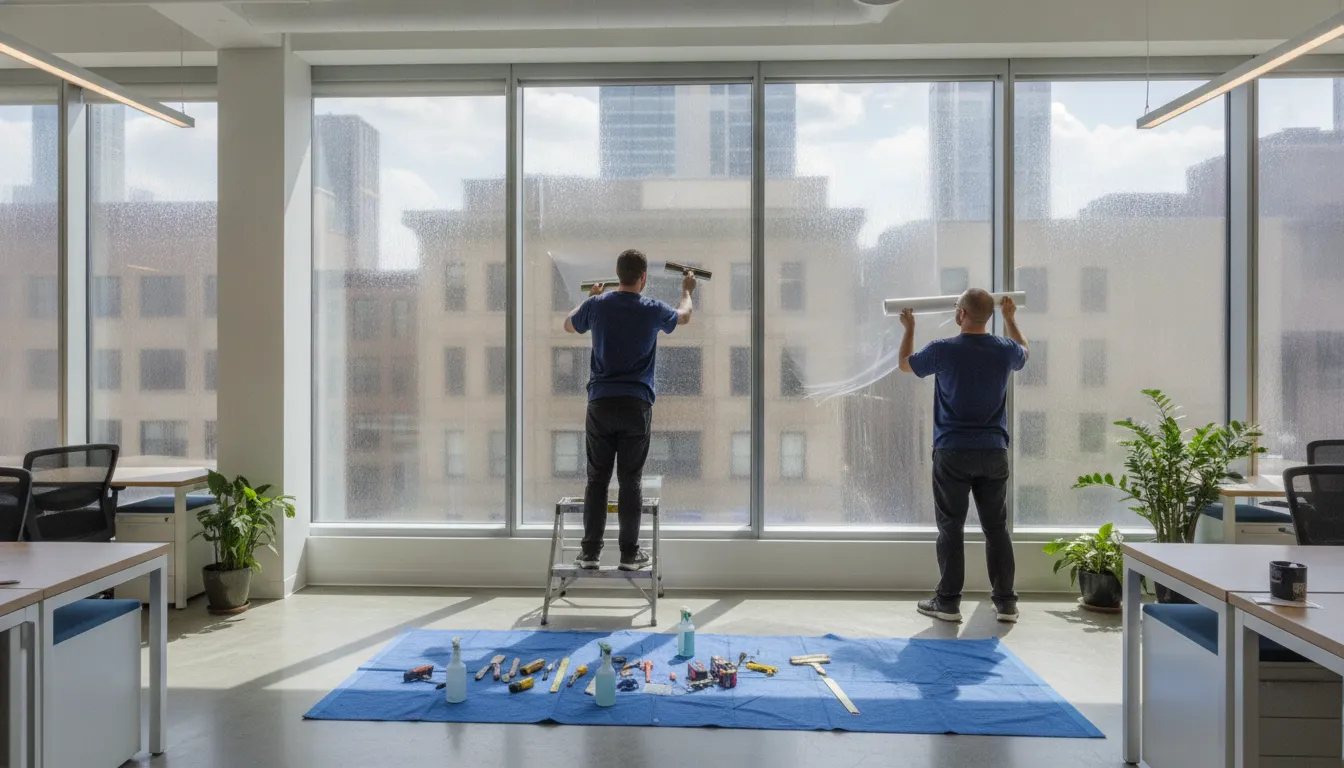
Commercial window film installation in Chicago is not governed by one standard number of hours or days. The project typically moves through planning, glass and work-area preparation, professional installation, curing, and final scheduling around your business operations. A smaller, accessible project with straightforward glass may move differently from a large building with varied glazing, restricted access, or staged work.
The commercial window film installation time Chicago businesses should plan for depends on the glass, glazing area, film category, access, preparation, crew coordination, and operating schedule. A site assessment and project-specific estimate confirm the sequence without making a fixed promise.
For property managers and business owners, the goal is a clean, factory-finished result with as little disruption as practical. Understanding which project conditions influence the schedule makes it easier to coordinate occupants, access, and installation phases from the beginning.
Request a free estimate for your Chicago commercial window film project.
What Affects Commercial Window Film Installation Time Chicago?
There is no single answer to the question, “How long is commercial window film installation time Chicago?” A small office with consistent glass. Clear access, and a straightforward film selection follows a different schedule. A large property with multiple glazing types, restricted access, or occupied work areas follows another. Sullivan’s Tinting does not publish a universal installation duration because the scope and complexity of each project vary.
The most useful way to think about the schedule is as a series of connected phases. First, the project is evaluated and planned. Then the glass and work area are prepared, film is installed, and the installation is reviewed and managed through the product’s curing requirements. The calendar for each phase depends on the building, selected film, and operating conditions.
| Project factor | Why it matters | What to confirm |
|---|---|---|
| Glazing area and layout | More windows, varied sizes, or multiple glass configurations can require a different work sequence. | Which panes, doors, and areas are included? |
| Access and preparation | Furniture, tenant areas, security rules, and surface conditions affect readiness. | Which spaces must be cleared or protected? |
| Film category | Solar control, privacy, decorative, and safety films have different purposes and guidance. | Which product fits the glass and goal? |
| Operating schedule | Occupied hours can shape access, staging, communication, and cleanup. | Should work be scheduled, staged, or performed after hours? |
Project size and glass configuration
Glazing area is one of the clearest scheduling variables. Large commercial projects may include many windows, different dimensions, or more than one glass configuration. The amount of access available around those windows matters as well. Tight corridors, furniture, tenant areas, security procedures, or difficult working heights can add coordination and preparation to the project.
Film selection and preparation
Film category and the condition of the glass also influence the work. A professional installer needs to account for the intended use, glass type, surface condition, and preparation required before application. Cleaning, protecting nearby areas, and addressing access restrictions are important parts of achieving a clean, factory-finished look. Those steps should not be treated as unnecessary delay.
Site schedule and business operations
For an occupied building, the site schedule is part of the installation plan. Work may need to be coordinated around employees, tenants, customers, or building access rules. A project-specific plan can help reduce disruption while keeping the work organized. To see how these considerations fit into a broader commercial project, review Sullivan’s commercial window film installation service information.
The reliable next step is an on-site evaluation and project-specific schedule, rather than a guessed number of hours or days.
Phase 1: Site Assessment and Project Planning
A reliable commercial window film schedule starts before installation day. The first step is a consultation that clarifies what the building needs, such as glare control, privacy, comfort, energy efficiency, or added security. For Chicago-area businesses, this conversation should also cover how the work will fit around occupants, customers, tenants, and normal operations.
Next, the installer completes an on-site estimate. This visit allows the team to measure the glazing, review window layouts and access conditions, and evaluate the condition of the glass. Glass type, existing imperfections, frame details, and the total area can all affect how the project is prepared and scheduled. A careful assessment helps avoid surprises that could interrupt the work later. Sullivan’s follows this consultation, measurement, glass evaluation, and planning process as part of its commercial service approach. Learn more about commercial window film installation.
The film recommendation is then matched to the glass, the building’s goals, and the planned work environment. Solar control, decorative, privacy, and safety or security films do not serve identical purposes. So the selected material should support the intended result rather than being chosen by appearance alone. The recommendation may also account for the building’s configuration and the areas that need to remain accessible during the project.
Once the scope and film type are established, material ordering and crew assignment become part of the plan. The appropriate materials, installation approach, team size, access requirements, and work sequence depend on project complexity. That means there is no responsible universal lead time for every commercial property. A larger building, unusual glazing, restricted access, or a multi-area installation may require a different plan from a smaller, straightforward project.
Before approving a schedule, discuss preferred work windows, preparation instructions, and any areas that must remain operational. To begin a project-specific conversation, request a free estimate. The site visit and measurements provide the information needed to recommend the film and coordinate the next phase without relying on an inaccurate fixed timeline.
Phase 2: Preparing the Glass and Work Area
Preparation is where a professional installation creates the conditions for a clean, factory-finished result. Before work begins, the installation team confirms access to each glazing area and identifies nearby desks, equipment, displays, or pathways that need protection. In an occupied commercial building, this coordination helps the crew work carefully without treating the space like an empty construction site.
The glass is then inspected for existing defects and imperfections that could affect the finished appearance or installed performance. Scratches, chips, seal issues, or other deficiencies that cannot be corrected before installation should be brought to the customer’s attention and documented. This step separates a pre-existing glass condition from an issue related to the film installation. The guidance for 3M safety and security film specifically calls for examining the glass and documenting deficiencies that remain before application: 3M installation guidance.
Cleaning is more detailed than simply wiping the pane. Immediately before installation, the glass, doors, and framing are thoroughly cleaned with a neutral pH solution. Any foreign contaminants may require careful removal with a clean, sharp stainless-steel blade that will not damage the glass. The frame on the installation side is wiped with a damp cloth or sponge so residue does not migrate onto the film.
Next, the installer rinses the glass from top to bottom with slip solution and squeegees the surface dry. The edges and frame are finished with an absorbent, lint-free towel. These details matter because dust, fibers, residue, or moisture at the perimeter can interfere with positioning and edge appearance. They also explain why a larger or more complex building may require more preparation even when the visible installation area seems straightforward.
Film selection is part of readiness, too. Solar control, privacy, safety, and anti-graffiti products have different purposes and compatibility considerations. Businesses can compare commercial film types before the crew arrives, then confirm the recommendation against the building’s glass, access conditions, and operating schedule.
What Happens During Commercial Film Installation?
On installation day, a professional crew turns the approved plan into a controlled, clean application. The exact work varies with the film category, glass configuration, access, and project requirements. The process is managed around the building rather than treated as a one-size-fits-all job.
After protecting the work area, the installer prepares the glass and frame for application. The selected film and the glass are wetted with a measured slip solution. The solution gives the installer enough positioning control to align the film accurately without relying on excessive detergent. Its concentration may be adjusted for the temperature and humidity in the installation environment, which can affect how the film moves and adheres. These environmental details are part of professional installation, not shortcuts a crew should ignore.
Once the film is positioned, the installer uses deliberate squeegee pressure to establish adhesion and move solution toward the remaining uninstalled areas. The work typically begins by tacking the film at key points, then continuing with overlapping strokes. This technique helps push slip solution and trapped air outward in a controlled pattern. Large bubbles are addressed before the main squeegee passes, while the installer keeps the film aligned and avoids disturbing the glass or frame.
Temperature, humidity, and the selected product also influence how the crew evaluates the application. Manufacturer instructions govern the acceptable conditions, particularly for specialty products such as safety and security film. A quality check looks for alignment, edge condition, visible bubbles, contamination, and the overall consistency of the finished surface. The objective is a clean, factory-finished result, not simply film placed on glass.
Commercial teams also account for the people and operations around the work. Sullivan’s professional standards include a clean installation environment and reduced disruption for occupants. For facilities with large or varied glazing areas, reviewing warehouse window film project needs can help clarify access and coordination questions before scheduling.
Because installation conditions and building layouts differ, the crew should confirm the project-specific sequence and schedule during planning rather than promise a fixed duration.
How Does Curing Affect the Project Timeline?
Installation labor ends when the film is positioned, adhered, and checked, but the project may still have a curing phase. Curing is the period in which moisture leaves the installation area and the adhesive settles against the glass. It is separate from the time a crew spends preparing the windows and applying the film, so a project schedule should account for both phases.
Conditions matter. Temperature and humidity should stay within the selected product’s manufacturer instructions. Room conditions may also need to be maintained to support adhesive curing. That makes temperature, humidity, airflow, glass condition, and the film category relevant to the final schedule. Review the manufacturer installation guidance for the selected product.
Product guidance also needs to be read carefully. One Lawrence Berkeley National Laboratory and GSA report describes a liquid-applied product that cured into a hard film in 30 minutes. That is a result for that specific product and application method, not a universal cure time for conventional films. Other installations may require different handling, environmental conditions, and follow-up expectations based on the manufacturer’s instructions.
Early visual changes can be part of the settling process, while persistent concerns should be reviewed by the installer against the product requirements. Sullivan’s provides care instructions, warranty documentation, and follow-up support. Review the commercial film warranty details and confirm the project-specific curing and inspection expectations before work begins.
How to Schedule Installation Without Disrupting Business
A commercial window film project should fit the way your building operates, not force your business to stop. Sullivan’s schedules work at customer convenience and provides preparation instructions for installation day. Early coordination with the property manager, facility team, tenants, and installer helps identify access requirements, sensitive areas, visitor traffic, security procedures, and the best working windows.
For an occupied office, hotel, or multi-tenant building, start with a simple communication plan. Notify occupants about which areas are affected, what preparation is expected, and whether furniture or work surfaces need to be moved away from the glass. Confirm who will provide access, how installers will enter the property, and where equipment can be staged. A clean installation environment and practical protection of surrounding areas are important parts of minimizing disruption for commercial clients.
After-hours work may be appropriate when daytime activity is especially sensitive. The Lawrence Berkeley National Laboratory and GSA report describes a studied retrofit in which installation could take place after work hours, with minimal loss of business-hour occupancy or productivity. The same report says work across many windows in a large building can be staged during unoccupied times. Those observations describe that specific retrofit and should inform planning, not guarantee the same result for every Chicago project. Building access, film category, glass configuration, site rules, and preparation needs still have to be evaluated.
Staging can also make a larger project easier to manage. An installer may coordinate one floor, tenant area, wing, or group of accessible windows at a time, allowing operations to continue elsewhere. For hospitality properties, review commercial installation planning for hotels. For offices, consider how scheduling supports the comfort and productivity goals discussed in commercial office film benefits.
During the consultation, ask for a project-specific schedule that accounts for the building’s occupied hours and communication process. That is more useful than relying on a fixed commercial window film installation time in Chicago, because the right plan depends on your property and the work involved.
What to Confirm Before Your Chicago Commercial Film Project
A clear pre-project conversation helps your installer match the film and work plan to the building, occupants, and operating schedule. Use this checklist when reviewing a commercial window film installation time estimate in Chicago:
- Define the glass and film scope. Identify the windows, doors, glazing area, glass condition, and access constraints. Confirm whether the goal is solar control, glare reduction, privacy, security, or a combination. Recommendations should fit the glass, project needs, film type, and schedule.
- Ask how the site will be evaluated. Confirm that the team will measure the glass, review configurations, and identify defects or conditions that could affect the finished appearance. Ask which findings will be documented before work begins.
- Review access and preparation. Clarify which rooms, floors, furniture, blinds, and work surfaces must be accessible. Discuss protection for nearby areas and any preparation instructions your staff or tenants should follow.
- Set workable hours and staging. Decide whether work should occur during normal operating hours, after hours, or in stages. For occupied offices, planning film work in occupied offices can help you coordinate occupants and reduce disruption. Ask how the crew will maintain a clean work area throughout the project.
- Confirm installation and cleanup expectations. Ask how the team will handle wet application, access between rooms, debris, water, and final cleanup. The goal is a professional installation with a clean, factory-finished look, not simply film placed on glass.
- Discuss curing and care. Request the selected product’s manufacturer guidance for environmental conditions, occupancy, cleaning, and post-installation care. Do not assume every film has identical curing instructions.
- Get the closeout documents. Confirm that you will receive care instructions, warranty documentation, maintenance guidance, and a point of contact for follow-up questions.
- Request a project-specific estimate. Ask what assumptions shape the schedule, crew plan, materials, and recommended film. Sullivan’s estimates are custom, so confirm the expected work sequence and any timing variables rather than relying on a fixed promise. A free estimate gives you a practical next step without committing to a one-size-fits-all plan.
Ready to plan your commercial window film schedule? Request a free estimate.
Frequently Asked Questions
How long does commercial window film installation take in Chicago?
There is no universal timeline. Glazing area, glass configuration, access, preparation, film category, crew planning, and your operating schedule all affect the project. Confirm a project-specific schedule after the site assessment.
What should a business do before the installation crew arrives?
Coordinate access to each work area, identify furniture or equipment that needs protection or relocation, and share building or tenant requirements. The installer should evaluate glass condition and prepare the surfaces immediately before application.
Can commercial window film be installed after business hours?
Often, scheduling can be coordinated around your operation. After-hours or staged work may help reduce disruption in occupied offices, retail spaces, and other facilities. The best approach depends on access, staffing, security, and the size of the project.
How does curing affect the project schedule?
Curing is product- and environment-specific, so it should not be treated as a fixed number of hours. Temperature, humidity, and the manufacturer’s instructions can affect post-application conditions. Review the selected product’s manufacturer installation guidance with the installer.
When can employees use the treated areas again?
Your installer should explain when each area can return to normal use and provide care instructions. That guidance can vary with the film, glass, work conditions, and any curing requirements, so confirm occupancy and cleaning instructions before the crew leaves.
Ready to Plan Your Chicago Commercial Window Film Project?
A project-specific review helps clarify the film recommendation, site preparation, and scheduling approach for your business. Sullivan’s Tinting can discuss your building, scope, and coordination needs before work begins.