
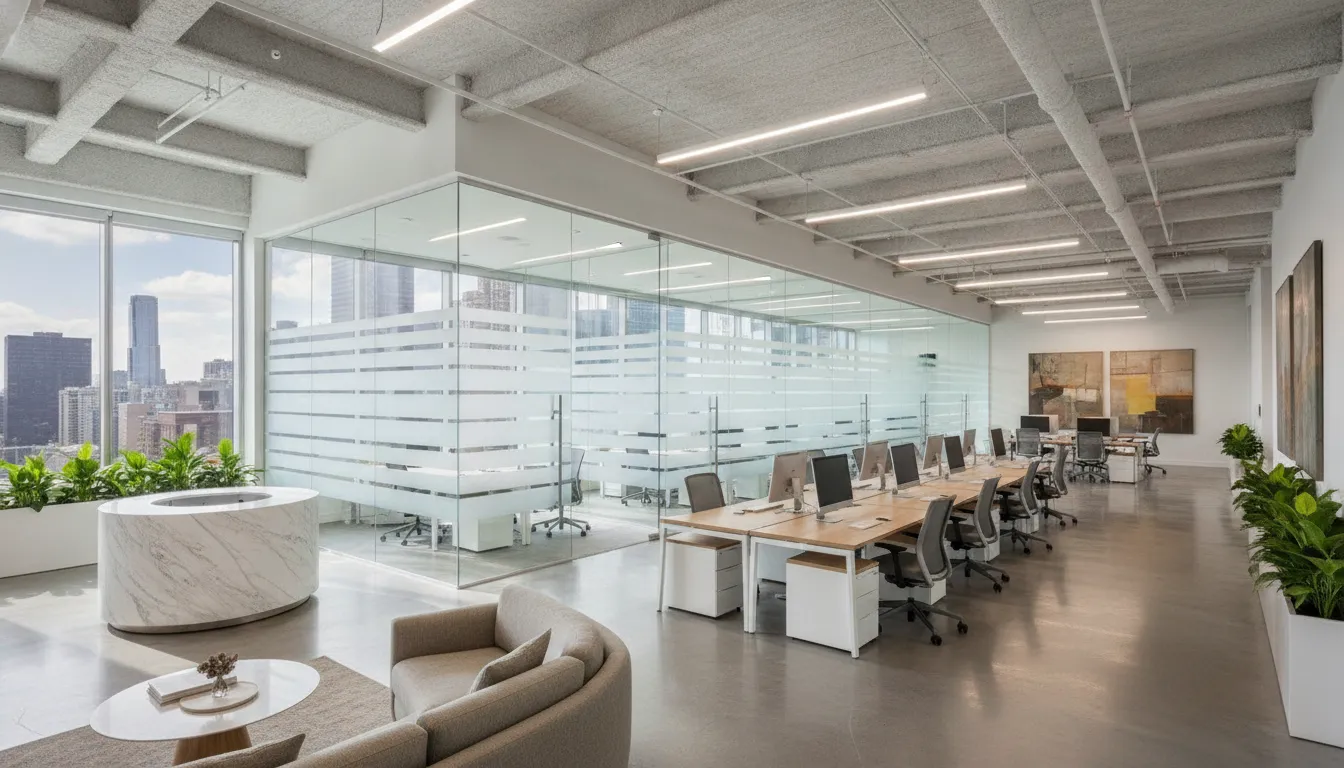
In an open-plan Chicago office, clear glass can make a space feel brighter and more connected. But it can also expose confidential conversations, distract employees, and create glare during meetings. Conference rooms, reception areas, and interior partitions often need a more deliberate balance between visibility and privacy.
Privacy window film Chicago offices can use frosted, patterned, reflective, or other purpose-specific finishes to limit unwanted views while preserving useful daylight. The right choice depends on whether the priority is visual privacy, glare control, branding, security, or a combination of goals.
Because privacy film is applied to existing glass, it can update the appearance and function of an office without replacing an entire glazing system. Start by identifying where sightlines create the greatest disruption, then consider how privacy, natural light, and the professional look of the workspace should work together.
Why Offices Need More Than Clear Sightlines
Answer capsule: Open-plan offices need privacy film when clear glass exposes confidential conversations, creates visual distractions, or produces glare on screens. The right film can define work zones and conference rooms while preserving a bright, professional feel.
Glass helps Chicago offices share daylight and create an open atmosphere, but unrestricted sightlines can work against the way teams actually use a workplace. A person walking past a conference room may see presentation screens, paperwork, or a sensitive discussion. In an open-plan area, constant movement in the peripheral view can interrupt concentration even when the office is otherwise quiet. These are practical reasons commercial property owners and office managers consider window film for workspaces, conference rooms, customer-facing areas, and visual space separation.
Privacy for conversations and shared spaces
Conference rooms often need a visual boundary without feeling closed off. Frosted or other privacy treatments can soften views through interior glass so a meeting remains private while the room still receives daylight. The goal is not necessarily to make every pane opaque. Depending on the layout, a partial treatment can protect seated occupants, obscure a screen, or create a defined band across a glass wall while leaving upper areas brighter.
This distinction matters in open-plan offices. Privacy film is not a substitute for every acoustic or security measure, and it does not make all conversations confidential by itself. It addresses visual exposure. For a broader look at how film is used in office settings, see Sullivan’s commercial window film for Chicago offices.
Less glare without losing the daylight
Uncontrolled sunlight can wash out computer screens and displays, forcing employees to reposition monitors, close blinds, or work around changing conditions. Commercial window film can reduce glare on screens and displays, which may make shared work areas more comfortable. Privacy and glare are related but separate goals: a frosted decorative film primarily changes visibility, while a solar-control selection is intended to manage light and solar heat. A consultation should account for the direction of the glass, the room’s use, and the level of daylight occupants need.
That balanced approach keeps an office welcoming instead of turning every window into a dark barrier. Sullivan’s can review existing glass and recommend a professional installation that supports privacy, sightline control, and a clean factory-finished appearance.
Which Privacy Window Film Chicago Offices Should Consider
Answer: The right film depends on whether the priority is visual privacy, glare and solar control, on-demand opacity, or protection against glass breakage. Frosted and decorative films are usually the clearest starting point for conference rooms and interior sightlines, while reflective, switchable, and safety/security films solve different problems.
These categories are not interchangeable. A film that obscures a conference-room view may not provide the solar performance or glass-retention properties a particular office needs. Start by identifying what people should see, what they should not see, and whether the glass also faces direct sunlight, high traffic, or a security concern.
| Film category. | Best suited for. | What to expect. | Important distinction. |
|---|---|---|---|
| Frosted or decorative | Conference rooms, office doors, partitions, and reception areas. | Obscures views while preserving brightness, with options for full, gradient, or patterned frost. | Primarily a visual privacy and design solution, not a substitute for security film. |
| Reflective or solar-control | Exterior-facing glazing with glare, heat, or strong sunlight concerns. | Can alter the appearance of the glass and support solar heat and glare control. | Performance and privacy vary by product, lighting conditions, and selected reflectivity. |
| Switchable | Rooms that need transparent and private states at different times. | Supports an adjustable privacy approach for meeting rooms or flexible spaces. | Requires a powered system and a project-specific review, so it is not the same as passive frost. |
| Safety/security | Entry glass, sidelights, and areas where breakage protection is a concern. | Designed around glass protection and safety goals rather than simply blocking sightlines. | It should be evaluated separately from decorative privacy needs and may be combined only when appropriate. |
Frosted and decorative film for controlled sightlines
Frosted film is often the most straightforward choice when an office needs privacy without turning a room into a dark enclosure. Full frost is used when complete visual privacy matters. Gradient frost can preserve more visibility toward one part of the glass, while patterned frost adds a design element. Sullivan’s also offers decorative possibilities such as patterns, custom graphics, branding, and textured appearances. Review the decorative and privacy window film options to see how existing glass can support both separation and a finished workplace appearance.
Design flexibility does not mean every pattern provides the same opacity. Clear and frosted sections can be combined, and branding elements may be incorporated when the layout calls for it. A professional installer can help match the privacy level to the room, sightlines, and desired daylight rather than applying the same finish everywhere.
When commercial performance matters as much as privacy
Tinted and reflective finishes are among the commercial window film options for Chicago offices. They may be more appropriate for exterior glazing where glare on screens, solar exposure, or occupant comfort is part of the brief. The goal may be to reduce visual strain while retaining useful daylight, not to create complete interior privacy. A solar-control film can therefore complement a frosted treatment, but it should not be presented as its replacement.
Switchable film is a different planning decision. It can suit a conference room that alternates between open visibility and private meetings, but the electrical requirements, controls, glass condition, and installation scope need review before selection. Safety/security film is different again. It addresses protection and glass-retention objectives, so choose it for a documented safety concern rather than assuming a decorative film provides equivalent protection.
For a Chicago office, the strongest recommendation is usually room-specific: compare sightlines, daylight, glare, appearance, and security goals before selecting a category. That approach produces a cleaner, more useful result than treating every window as the same problem.
Where Privacy Film Works Best in an Office
Answer: Privacy film is most useful where people need visual separation without sacrificing a bright, welcoming workplace. Conference rooms, glass doors, partitions, reception areas, and sensitive offices can all benefit, but the right opacity and pattern depend on the room’s sightlines and purpose.
Conference rooms and glass doors
Conference-room glass can create an open, modern look. It can also expose presentations and confidential conversations to passing employees or visitors. Frosted film can obscure views across the center of a glass wall while leaving selected areas clear. Full frost supports a more private room. A gradient or partial treatment can preserve some visibility and daylight.
The same approach works on office doors and sidelights. A measured band or patterned treatment can improve privacy without making the entry feel closed off. These applications are commonly used for doors, conference rooms, reception areas, and partition dividers (application examples).
Partitions, reception, and confidential spaces
In open-plan offices, film can create visual boundaries between workstations without rebuilding the space. Reception glazing may need enough privacy to protect behind-the-desk activity while still appearing approachable. HR offices, legal work areas, and medical settings may also need reduced sightlines around sensitive conversations. Privacy film can support that objective, but it should not be treated as a guarantee of legal or regulatory compliance. Confirm the applicable requirements for your space and choose a film design with the appropriate professional guidance.
Leased offices and branded glass
Because privacy film is applied to existing glass, it can be a practical retrofit and an alternative to replacing glass with etched or sandblasted panels. That makes it worth considering for leased offices where structural changes are restricted. Before scheduling work, confirm landlord or building approval, permitted adhesives or finishes, future removal expectations. And any requirements for marking clear glass walls or doors for visibility and accessibility. These considerations do not replace advice from your landlord, building manager, or qualified compliance professional.
Privacy does not have to look generic. Clear and frosted sections can be combined, and patterns, logos, or other branding elements can turn a functional glass treatment into part of the office design. Review Sullivan’s window film FAQs for common installation questions, then check the company’s Chicagoland service areas to confirm coverage for your office location.
How Film Supports Office Comfort and Professional Appearance
Answer capsule: Commercial window film can make an office feel more usable and look more intentional by reducing screen glare. Managing sunlight, protecting interior finishes from UV exposure, and adding a consistent finish to existing glass. The right film supports comfort without treating every window or film category as interchangeable.
Reduce glare while preserving useful daylight
Bright windows can create reflections across monitors, displays, and conference-room surfaces. Commercial window film can reduce glare on computer screens and displays, helping employees and visitors use the space more comfortably. A solar-control film may be appropriate where the primary concern is sunlight and visible-light management, while a decorative or privacy film addresses sightlines and visual separation. Those goals can overlap, but the recommendation should follow the glass, room orientation, and way the space is used.
Daylight should not be treated as a problem to eliminate. A U.S. Department of Energy case study describes a high-performance film designed to provide year-round performance without excessively reducing visible light transmittance. That is a description of the product and case study, not a promise that every film will produce the same result. A peer-reviewed office study also associated optimized daylight and views with longer sleep and higher scores on specific cognitive simulations. It does not establish that installing film alone will create those outcomes. It does reinforce the value of balancing glare control with a bright, welcoming workplace.
Protect interiors and improve the experience of the space
Commercial film can help protect interior investments and merchandise from UV exposure. In an office, that may include furnishings, finishes, displays, and other materials positioned near glazing. Film selection matters: privacy, solar-control, decorative, safety/security, and switchable films serve different purposes. If a project also involves concerns about glass breakage or vulnerable entry areas, review safety and security window film separately rather than assuming a frosted finish provides the same protection.
Appearance is equally practical. Professional installation is intended to produce crisp lines, a smooth finish, and resistance to peeling or discoloration. That clean result can make conference rooms, sidelights, and partitions feel coordinated instead of improvised. Browse Sullivan’s completed window film projects to see how different finishes can support a polished commercial environment.
Plan for a low-disruption installation
Commercial installation is designed to minimize business disruption and uses professional-grade films selected for durability. A site-specific review helps determine the appropriate finish, access plan, and installation sequence so the work supports daily operations rather than interrupting them unnecessarily.
What to Confirm Before Commercial Installation
Answer: A successful office privacy film project starts with a site-specific plan. Confirm the privacy outcome, glass conditions, film category, building requirements, installation logistics, care instructions, and warranty details before work begins.
- Define the privacy goal. Identify which conversations, work areas, or sightlines need screening. A conference room may need stronger visual separation than a reception partition, while an open office may need privacy without losing a bright, welcoming feel. Note whether you want full obscurity, partial screening, a decorative pattern, or a branded design. This gives the installer a practical brief instead of leaving privacy levels open to interpretation.
- Inspect the glass and surrounding sightlines. Review each window, door, sidelight, and partition from both sides. Record dimensions, frame conditions, existing film, and hardware. Note areas where people approach or pass through the glass. Privacy film is applied to existing glass, so this review helps determine preparation needs and visibility. Ask the installer to flag surfaces that need special attention before scheduling.
- Choose the film category that fits the problem. Decorative and privacy film addresses visual separation, while tinted or reflective commercial film may address glare and solar control. Safety and security film serves a different purpose, and switchable film offers a different operating experience. Review Sullivan’s commercial and decorative window film services to compare categories without treating them as interchangeable.
- Confirm landlord and building requirements. For leased offices, obtain written approval before ordering materials. Check whether the building has rules for glass visibility, safety markings, appearance, access, or future removal. Clear or newly covered doors and walls may need visibility treatments, so include facility management in the review rather than assuming the film design is approved.
- Plan access and timing around business operations. Identify loading procedures, parking, security check-in, furniture relocation, restricted areas, and the best work windows. Commercial installation is intended to minimize business disruption, but the installer still needs accurate information about access and occupied spaces. Confirm what areas must be clear and how the space should be treated after installation.
- Ask about the finish, care, and warranty. Review the expected appearance, cleaning guidance, and product-specific warranty terms. Professional installation should produce crisp lines and a smooth, clean finish. Sullivan’s also emphasizes manufacturer-backed warranties, so ask which coverage applies to the film selected for your project and what documentation you will receive.
- Request a custom estimate. Provide the glass list, access details, privacy objectives, and preferred timing. Installation scope depends on factors such as film type, glass area, access conditions, and preparation or removal work. Request a free estimate for your office so the recommendation reflects your actual building rather than a generic retail figure.
Request a free estimate for Chicago office privacy film
Frequently Asked Questions
What privacy film works best for open-plan offices and conference rooms?
That depends on the room and the sightlines you need to control. Full frosted film provides the most visual separation, while gradient or patterned frost can preserve selected clear areas and add design interest. A professional installer can recommend the finish for conference-room glass, office doors, reception areas, or partition dividers.
Can privacy film improve privacy without blocking natural light?
Yes. Frosted and decorative films can obscure views while retaining daylight. Opacity, pattern, and coverage affect how much visibility and light transmission remain. So the right choice depends on whether the priority is confidential conversations, reduced distractions, or a brighter shared workspace.
Can privacy film be installed in a leased Chicago office?
Often, yes. Because film is applied to existing glass, it can improve privacy without replacing the glass or making structural changes. Before scheduling work, confirm approval with the landlord or building manager, including any requirements for visibility markings, access, and future removal.
How much does commercial privacy film cost?
There is no universal price for an office installation. Film type, glass area, access conditions, surface preparation, and any removal work can affect the total. A site-specific review is the best way to match the recommendation to your glass and scope. Visit the window film FAQs or request a free estimate for office privacy film.
Ready to Plan Your Office Privacy Film?
The right privacy film can help open-plan offices and conference rooms feel more focused while preserving the look and daylight of the existing glass. A site-specific recommendation helps match the film to your rooms, sightlines, and project goals.
Request a no-obligation free estimate for office privacy film