
Privacy window film can soften unwanted views through glass while preserving some daylight, but the right option depends on the sightline, the room, and when privacy matters. Frosted, patterned, reflective, and opaque films create different effects. Compare them by what you can see through the glass, how the room feels in natural light, and whether the treatment needs to work after dark.
Request a free estimate for your windows
What should privacy window film do in your space?
Answer capsule: First define which views you want to obscure, when you need privacy, and how much daylight or outward visibility you want to keep. A bathroom, front entry, street-facing living room, and conference room can have very different requirements.
Start by observing the glass from the places people approach or use the room. Look from the sidewalk, a neighboring building, an interior hallway, or the next room. Check more than one angle and height. Someone seated may have a different view from someone standing, and a direct view from close to the pane may differ from a view across the street.
Write down the problem before comparing samples. For example, “people on the walkway can see the entry hall at eye level” is more useful than “the window needs privacy.” The first description identifies a direction, a height, and a place to evaluate. It also leaves room to consider a privacy band rather than covering every pane.
- Privacy level: Do you want to blur detail, make faces hard to recognize, or block the view through the covered area?
- Daylight: Is keeping a bright room important, or can the treated area be darker?
- Outward view: Do you want to see clearly outside, see only light and shapes, or give up the view?
- Timing: Is privacy needed in daytime, after dark, or throughout the day and evening?
- Appearance: Should the finish disappear into the glass, create a pattern, or stand out as a design feature?
- Coverage: Does the whole pane need film, or would selected sections address the main sightline?
These priorities can conflict. A treatment that blocks a clear view may also reduce the outward view. A finish that admits diffused light may not hide every silhouette at close range. Sullivan’s decorative and privacy film services are one place to review the available application category before discussing a particular project.
How do the main privacy film options compare?
Answer capsule: Frosted film diffuses views while allowing light through; patterned film interrupts sightlines to varying degrees; reflective film depends on which side is brighter; and opaque film blocks the view through the covered area but also removes transparency there.
| Film approach | Typical view effect | Light and outward view | Good starting point for |
|---|---|---|---|
| Frosted or etched-look | Softens detail and direct sightlines | Allows diffused light; clear views through treated glass are reduced | Bathrooms, sidelights, interior partitions |
| Patterned or decorative | Disrupts views depending on pattern density and coverage | May retain light; open sections can leave partial views | Entry doors, offices, design accents |
| Reflective | Can limit views from the less-bright side under suitable conditions | May retain a view in some lighting; appearance is more reflective | Exterior-facing glass where daytime privacy is a priority |
| Opaque | Blocks direct views through the covered portion | Greatly limits or eliminates light and view through that portion | Selected panels needing strong visual screening |
The table is a comparison of film approaches, not a promise that every product in a category performs alike. Opacity, pattern scale, glass placement, viewing distance, and the difference in brightness between indoors and outdoors can all affect what a person sees. Ask to review a sample against the actual glass, and assess it from the side where privacy matters most.
For an overview of window-film terms and consumer information, the International Window Film Association is a relevant professional-association resource. A specific product sample and assessment of the actual window remain important for selecting a suitable finish.
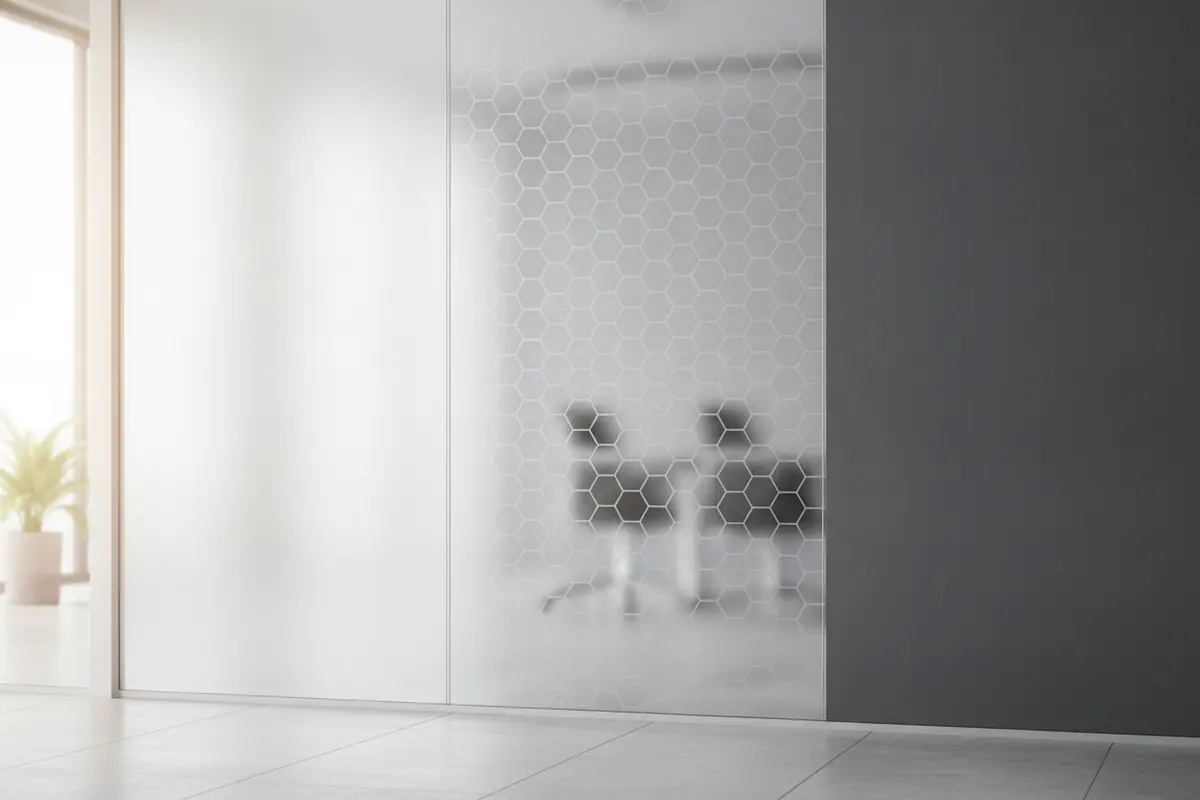
How does frosted film balance privacy and daylight?
Answer capsule: Frosted film diffuses light and softens a direct view, making it a useful option when you want visual screening without a solid covering. The exact level of privacy and light depends on the selected finish and how much of the glass is treated.
Consider frosted film for a bathroom window, glass door, sidelight, or office partition where people may pass close to the glass. It can obscure detail while still allowing light to spread into the room. But “frosted” does not mean every product has the same opacity. Close-up shapes or movement may remain noticeable with some finishes, so look at a sample at the window rather than relying on the name alone.
Coverage is another design decision. Full-height treatment can provide a more consistent screen across the pane. A horizontal band may address seated or standing sightlines while leaving clear glass above or below. Partial coverage is not a substitute for full privacy: a person can still see through untreated areas, and someone changing position may find a new angle.
Before choosing a band, map the relevant sightlines. Stand where an outside visitor or passerby would stand, then check where the band falls from inside while seated and standing. In a bathroom or a room facing a nearby building, consider whether someone could look around or above the treated section. For more residential ideas, see this guide to decorative window film for homes.
When is patterned privacy film a good fit?
Answer capsule: Patterned film is a fit when you want to interrupt a view and add a design element. Privacy depends on the design’s density, the size of its open areas, and where the film is placed, so compare the pattern on the window rather than judging a small image alone.
Patterns range from subtle textures to prominent geometric designs. A dense pattern can obscure more of the scene than a sparse one. An open motif can preserve a stronger sense of connection between spaces but may leave people or objects recognizable. Consider the view from both sides: a design that looks restrained from one direction may appear busier when repeated across several panes.
Pattern can also help identify glass doors and partitions. A decorative section can distinguish a clear panel from the surrounding space while screening selected views. In an office, decide whether the pattern should create a private meeting area, mark a glass partition, or simply soften the background. At home, compare the finish with nearby surfaces and the room’s daylight.
Plan alignment across adjoining panes before settling on a design. Repeated lines or motifs can look uneven if they do not meet consistently at mullions or door edges. See how decorative film can create a stained-glass look for another way film can change existing glass without replacing it.
Can reflective film provide privacy at night?
Answer capsule: Reflective privacy depends on the relative brightness on each side of the glass. If it is brighter outdoors, the exterior may appear more reflective; when a lit interior is brighter after dark, the effect can weaken or reverse. Do not treat reflective film as guaranteed around-the-clock privacy.
This matters in bedrooms, living rooms, offices, and meeting spaces used after sunset. During the day, sunlight may make the outside brighter. At night, lamps and room lighting can make the interior the brighter side. Someone outdoors may then see more into the room than during the day. A separate nighttime covering may still be needed when privacy is important after dark.
Reflective film also changes the appearance of the glass and can affect visible light and the outward view, depending on the product. Consider how the exterior will look from the street, whether the window faces another building, and how the room is used at different times. Ask an installer to explain the chosen product’s limitations under your lighting conditions.
A simple evaluation is to check the window during the day and again after dark, with the room lights on. Look from the actual outside approach, not just from directly against the glass. If reliable privacy is needed in both conditions, plan for a combination of measures rather than assuming a reflective surface will work the same way at every hour.
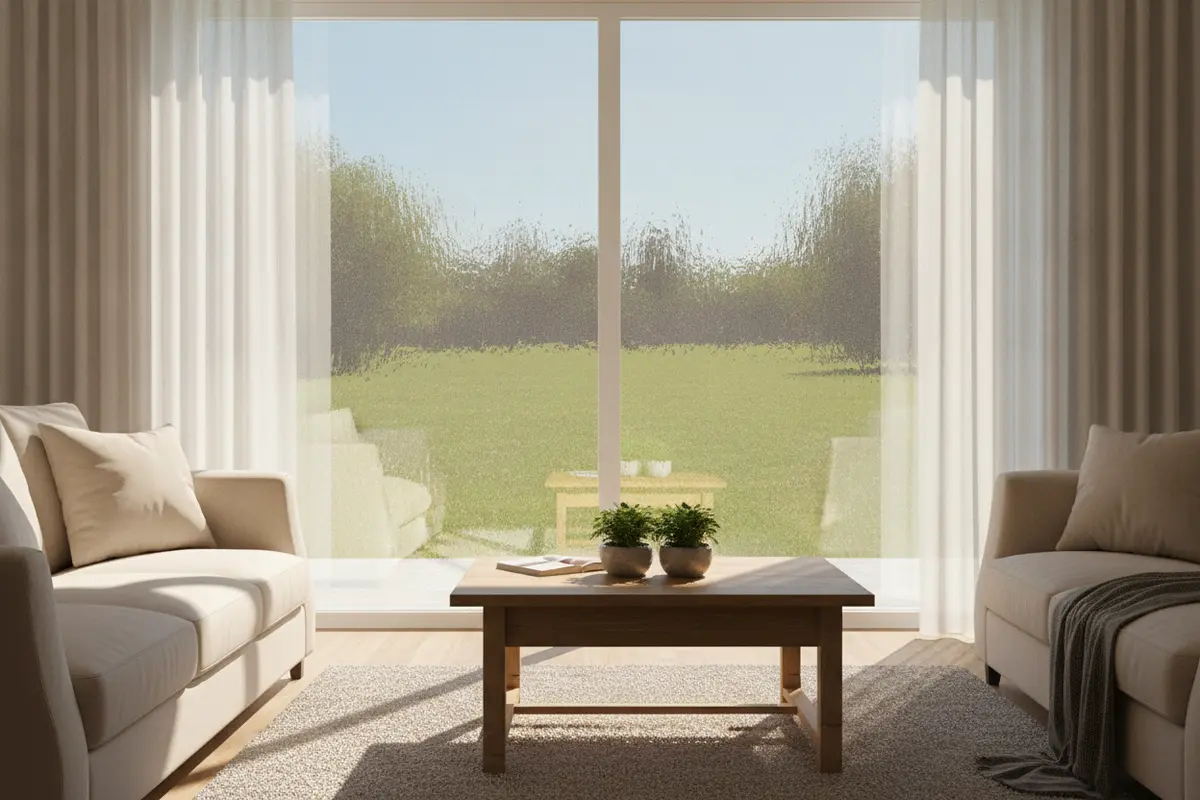
What does opaque film offer that translucent film does not?
Answer capsule: Opaque film blocks the direct view through covered glass more completely, but it also removes transparency and limits light through that section. Choose it where visual screening matters more than seeing through the pane.
Opaque coverage can suit a selected panel, a glass partition, or a section where a clear view is not needed. It may be excessive for a living area where people want daylight and a connection to outdoors. Before deciding on full coverage, consider whether an opaque band or one treated pane could solve the specific problem while leaving other glass clear.
Check boundaries carefully. If only part of a pane is covered, the untreated section remains a sightline. If multiple panels are involved, note which ones need screening and whether the treatment should align across them. Describe what you need to obscure rather than relying on a product label such as “privacy.” Ask whether silhouettes, movement, or details may be visible at close range.
How can you choose by room and sightline?
Answer capsule: Match the film to the view you need to soften, the light you want to preserve, and the hours when privacy matters. A bathroom may need broad screening, a conference room may need a designed band, and a street-facing room may require a day-and-night plan.
- Bathroom: Consider frosted or opaque coverage where direct views would be uncomfortable. Check neighboring windows and the height of the glass before choosing partial coverage.
- Front door or sidelight: Frosted or patterned film can soften a direct view while allowing light to pass. Decide whether visitors should still be visible from inside.
- Home office: Identify whether the concern is an exterior view, a sightline from another room, or both. Interior glass and an outside-facing window may need different treatments.
- Conference room: A band or pattern can screen some eye-level views while keeping a visual connection to the office. Check it from seated and standing positions.
- Street-facing living room: Reflective film may help under some daytime lighting conditions, but consider evening use and whether curtains or blinds are needed after dark.
- Storefront or reception area: Decide which views should remain open for visitors and which portions should be screened. A full opaque treatment may block useful visibility along with unwanted views.
For each room, make a short use-case note: who needs privacy, from whom, at what time, and whether light or view is the higher priority. A bathroom window with a nearby neighbor calls for a different assessment than a meeting room used only during the workday. If privacy needs to change between clear and screened, learn about switchable film for residential spaces; it is a different category from a fixed privacy finish.
It can help to bring photos showing the window from inside and from the relevant approach outside. Include the time of day and whether interior lights are on. This does not replace viewing a physical sample, but it gives the installer useful context when discussing coverage and likely trade-offs.
How can you test options before settling on a film?
Use a simple comparison process instead of choosing by product name or a sample viewed under showroom lighting. Start with the window that creates the greatest concern. Note the direction the glass faces, what lies beyond it, how close people can get, and whether the room is used after sunset. Then compare candidate finishes against the same conditions.
- Set a clear test question. For example: “Can a person on the walkway make out faces at the entry?” or “Can a seated person in the conference room see through the door?” A focused question makes it easier to decide whether a sample helps.
- Judge privacy and daylight separately. Look at what detail is obscured, then consider whether the remaining light and view feel acceptable. A sample might provide enough screening but reduce visibility more than you want.
- Repeat the check at different times. Reflective finishes especially need to be considered under changing light. For other finishes, compare daytime and evening room use to confirm the appearance suits the space.
- Check the edges and neighboring panes. A treatment can screen the center of one window yet leave a clear view through a sidelight or an uncovered strip. Look at the full opening, not just the sample square.
- Record the trade-off. Decide which matters most if you cannot have everything: stronger screening, more daylight, an outward view, or a particular decorative look.
Consider a street-facing living room as a worked example. If people outside can see the seating area during daylight and the homeowner wants to keep the room bright, a translucent finish or a carefully placed patterned treatment may be worth comparing. If the same room needs privacy at night, a reflective finish by itself may not address the evening condition. The selection process should include both the daytime view and the need for a separate nighttime covering.
Now compare a meeting room with an interior glass wall. The privacy issue may be limited to people passing in a corridor, while the business still wants daylight to move through the office. A band or patterned section can be evaluated at standing and seated eye levels. If confidential activity needs stronger screening, consider whether the treated area must be larger or more opaque. The intended use—not the room label—determines the relevant test.
These examples do not prescribe a single product. They show why you should define a sightline first, then weigh coverage, light, appearance, and time of use together. If two options both address the view, the sample review can help reveal which one better suits the room’s daily use.
What should you ask before professional installation?
Answer capsule: Ask how the proposed film behaves from each side, how lighting affects privacy, what view and daylight will remain, and whether the existing glass is suitable. Confirm the planned coverage and care guidance before approving the work.
- Describe the specific sightline. Point out where someone can see in and the times when it matters. Say whether you need faces obscured, a general blur, or a stronger screen.
- Review a sample at the glass. View it in the actual room and at the relevant time of day. A sample under unrelated lighting may look different from the finished window.
- Check both directions. Look from indoors and outdoors, and try seated and standing positions. Include the likely approach path, not only a straight-on view.
- Discuss lighting and nighttime use. If considering a reflective finish, ask what happens when the interior is brighter than the exterior and whether another covering may be needed.
- Confirm glass compatibility. Have the installer assess the existing glass and recommend a suitable film category instead of assuming every film works on every pane.
- Agree on coverage and appearance. Identify the exact panes or portions to be treated and discuss how the edges and adjacent sections will look.
- Ask about aftercare and warranty. Review product-specific cleaning guidance, curing expectations, and the applicable warranty information.
Professional measurement and application help create a consistent, factory-finished look. Sullivan’s about page describes the family-owned business, and its window film FAQs address common questions. You can also review the project gallery to see examples of different film appearances.
For context about the company’s wider offerings, see its window film services page. To prepare for a project discussion, the buyer’s guide to privacy window film for homes is another relevant resource. A free estimate is an opportunity to explain the glass, the sightlines, and the result you want; pricing depends on project details, so request an assessment rather than relying on a generic figure.
Request a free estimate for privacy window film
Frequently asked questions
Does privacy window film block every view?
No. Many translucent finishes blur a view rather than completely block it, and patterned designs may leave open areas. Opaque film blocks more of the view through the covered portion, while reflective privacy changes with relative brightness.
Can people see through reflective film at night?
They may be able to see in when the interior is brighter than the exterior. Reflective film should not be treated as a reliable substitute for nighttime coverings when the room needs privacy after dark.
Will frosted film make a room dark?
Frosted film diffuses light, but the effect depends on the product and the amount of glass covered. Review a sample at the window to judge how the room looks in its normal lighting.
Can privacy film be used on interior glass?
Yes. Privacy and decorative film can be considered for interior partitions and doors as well as exterior-facing windows. The suitable finish depends on the glass, desired appearance, and sightlines to address.
How do I know whether partial coverage is enough?
Check the treated section from the relevant approach and from seated and standing positions. If someone can still see through an untreated area or around the film, consider changing the band’s height or treating a larger portion.
Ready to choose a privacy film?
Share the room, the sightlines, and the times you need privacy when requesting an estimate. Sullivan’s can help you compare options and plan professional installation for your glass.
Request your free estimate today
A clear description of the view you want to soften is the best starting point for choosing a film that balances privacy, daylight, and appearance.