
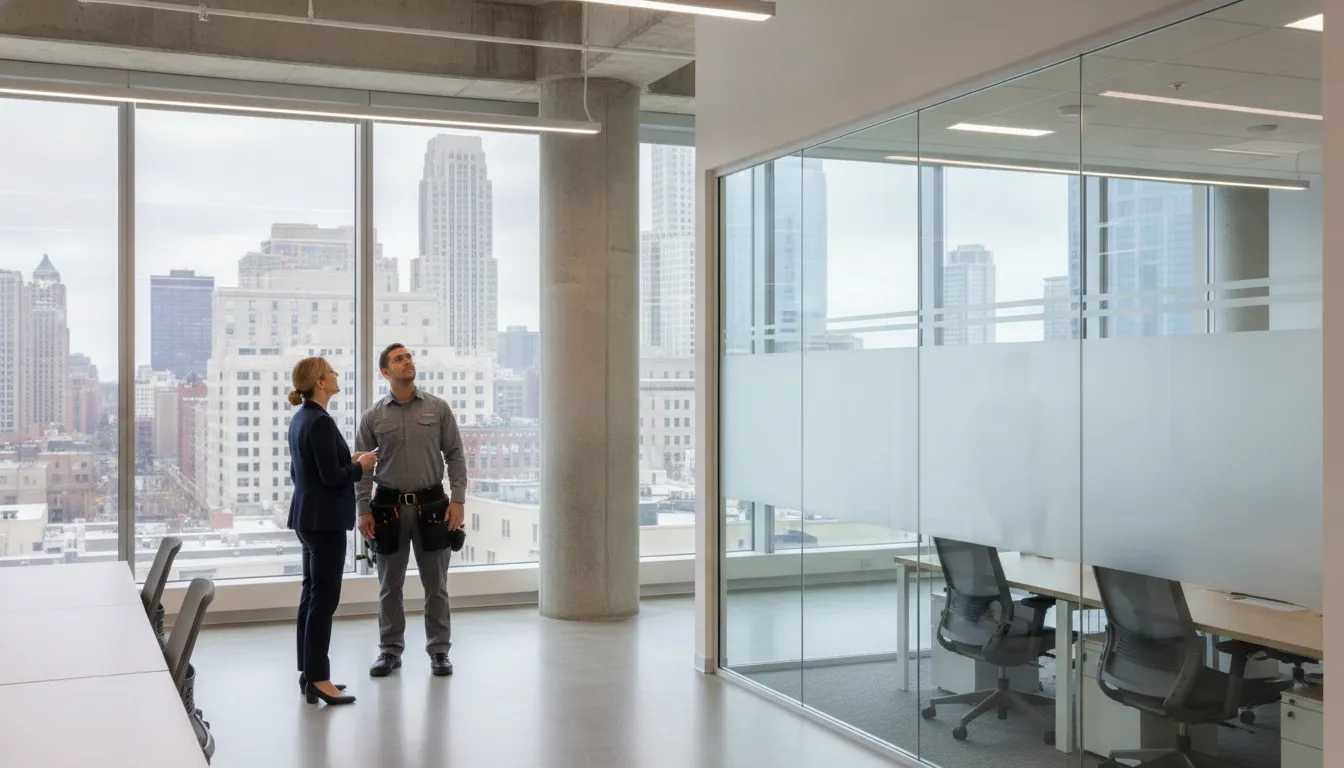
Government offices have to balance several window concerns at once: clear communication and privacy, comfortable work areas, useful daylight, and responsible protection of occupied spaces. The right film depends on the building, the glass, the people using each room, and the outcome the facility team needs to improve.
For window film Chicago government offices, start by matching the film category to the job: solar-control film can address heat and glare. Privacy or decorative film can obscure views while preserving brightness, and safety/security film can help hold broken glass together. Confirm glazing compatibility and any applicable building or agency requirements before selecting a product.
A practical decision process makes it easier to avoid choosing a film based on appearance alone. The sections below cover the questions facility managers should answer first, from sightlines and daylight to glass type, occupied-space scheduling, and installation goals.
Request a free estimate for your office window film project
What Should Government Offices Consider Before Choosing Window Film?
Short answer: Government facility managers should evaluate window film by the building’s operational goals, occupied spaces, sightlines, heat and glare conditions, glazing type, and installation requirements. Privacy may matter, but it is only one part of a responsible selection process. A written review of these factors helps the team choose a film that fits the facility rather than treating every office window the same.
Start with the facility’s actual needs
Map the areas where window conditions affect daily operations. Public-facing reception areas may need better visual control, while conference rooms or interior offices may require privacy without making the space feel closed in. Workstations near exterior glass may be affected by excessive heat or glare, which can make employees and visitors uncomfortable. Sullivan’s notes that every job is customized around the client’s goals, style, and budget. So the recommendation should begin with the facility’s priorities instead of a predetermined film type: project goals and conditions.
Ask practical questions before comparing products:
- Which windows create glare on monitors or discomfort during occupied hours?
- Where are sightlines a concern, and is the need daytime privacy, continuous privacy, or selective privacy?
- How important are daylight, exterior views, appearance, and consistent treatment across adjacent rooms?
- Are there areas where glass protection or reduced fragmentation is part of the facility’s risk discussion?
Review glazing and project requirements before choosing a film
Glass is not interchangeable. A DHS SAVER summary identifies annealed, heat-strengthened, fully thermally tempered, and polycarbonate glazing, noting that annealed and fully thermally tempered glass are common in office buildings. That distinction matters because glazing type and the conditions of the project should be assessed before a film is recommended. Review the existing glass, frame details, window orientation, access, and room use with an experienced installer. The assessment should also account for any applicable building, owner, or agency requirements that the facility team must confirm independently.
For teams documenting a purchase or renovation decision, the DHS SAVER program is a useful example of why product evaluation deserves structure. DHS describes SAVER as a program that helps emergency responders make procurement decisions, not as a blanket approval for any particular film or project. Facility managers can apply the same disciplined mindset by recording the problem, comparing relevant film categories, confirming glazing suitability, and identifying how the installation will affect occupied areas. See the DHS window film assessment summary for background.
This approach keeps the project distinct from a privacy-only office review. Privacy can be one objective, but a government office also needs a defensible match between the film, the glass, the occupants, and the facility’s broader operating requirements.
Which Window Film Types Fit Chicago Government Offices?
Answer: The right choice depends on the room’s primary need, not on the building label. Solar-control film suits perimeter offices with heat and glare, decorative or privacy film suits glass where sightlines need to be softened. Safety/security film supports a glass-retention strategy, and switchable film provides privacy that can change with the room’s use. A facility assessment should confirm the glazing, daylight goals, occupancy, and operational requirements before installation.
For many Chicago government offices, more than one category may make sense. A public-facing reception area may need glare control, while a conference room or interior sidelight may need privacy. A security-sensitive zone may require a separate review of glass type and protection objectives. The categories below are starting points for planning, not interchangeable products.
| Film type | Best for | Planning notes |
|---|---|---|
| Solar-control | Perimeter offices, waiting areas, and workstations affected by sunlight, heat, or screen glare. | Look for heat-rejection and visible-light performance that support comfort without making the room unnecessarily dark. A U.S. Department of Energy case study describes high solar heat rejection and low-emissivity performance for one window film, with year-round performance and no excessive reduction in visible light transmission. Read the DOE case study. |
| Decorative/privacy | Conference rooms, interior partitions, reception areas, and doors where visual separation matters. | Frosted or decorative film can obscure views while maintaining brightness. Specify the desired level of privacy and whether the finish should be partial, patterned, or full-height. This category changes visibility and appearance, not the glass’s basic function. |
| Safety/security | Areas where reducing loose glass after breakage is part of a broader risk review. | Safety/security film can help hold broken glass together, but it does not make glass unbreakable or replace a complete security design. Confirm the existing glazing and project objectives with qualified professionals. The customer’s safety and security film guidance explains the intended role and limitations. |
| Switchable | Conference rooms, interview rooms, and spaces that alternate between collaboration and private conversations. | Switchable film can change glass from clear to frosted for on-demand privacy. Plan for the electrical and control requirements, the desired switching behavior, and the appearance when the glass is clear or frosted. |
Selection also depends on how the space is used throughout the day. Solar-control film may address comfort at exterior windows, while privacy film can preserve daylight in an interior meeting room. Switchable film offers flexibility, but its control system must fit the facility’s operating practices. Safety/security film deserves especially careful coordination because the film’s performance depends on the glazing and installation details. For a broader review of finishes and applications, see these commercial window film options.
A professional installer can measure the glass, discuss the facility’s goals, and recommend a combination that delivers a clean, factory-finished appearance without treating every window the same.
How Can Solar-Control Film Improve Office Comfort?
Answer: Solar-control window film manages solar heat gain and glare while preserving useful daylight. In an office, that can mean more consistent temperatures, fewer distracting reflections on screens, and a more comfortable experience for employees and visitors. The right film can also help protect interior furnishings from ultraviolet exposure without turning every window into a dark barrier.
Sun-facing offices often experience uneven comfort. Areas near west- or south-facing glass may feel warmer, while glare makes monitors and shared displays harder to read. Sullivan’s commercial window films are designed to balance indoor temperatures and cut screen glare, addressing practical conditions that can make employees and customers uncomfortable. The recommendation should be based on the building’s orientation, existing glazing, room use, and desired appearance rather than on a one-size-fits-all tint.
Control heat without giving up daylight
Solar heat gain control reduces the amount of solar energy passing through the glass and entering the occupied space. That does not mean eliminating sunlight or outside views. A Department of Energy case study describes a high-performance film with high solar heat rejection and low-emissivity performance. The same source notes that the film can provide year-round performance without excessively reducing visible light transmission: read the DOE case study. For public-facing offices, that balance can be especially useful when teams want a brighter interior without the discomfort of direct sun.
Glare control is equally important. A conference room may have plenty of daylight but still be difficult to use if reflections wash out a presentation. Workstations beside exterior windows can face similar problems throughout the day. A solar-control recommendation should consider where people sit, which windows receive direct sun. And whether the priority is screen visibility, visitor comfort, or a consistent appearance across the facade. For a closer look at this application, see solar control for Chicago offices.
Protect interiors from ultraviolet exposure
Window film can also support interior protection. Sullivan’s materials state that window film can block up to 99% of harmful UV rays. A benefit for offices with upholstered furniture, flooring, displays, and paper materials near windows. UV protection does not replace sensible building care, and it does not mean every film performs identically. Film type, glass, installation conditions, and the specific product specification all matter, so a professional assessment is the best way to match the treatment to the space.
When Is Safety or Security Film the Better Choice?
Answer capsule: Safety or security film may be the better choice when a facility wants to reduce the hazard of shattered glass. Add a layer of protection to existing glazing, or address a defined security concern without immediately replacing every window. It can help hold broken glass together, but it does not make glass unbreakable or guarantee that an intrusion, blast, or other event will be stopped.
For a Chicago government office, the decision should begin with the building’s risk profile rather than the film label. Consider ground-floor exposure, public entrances, interior glass near occupied areas, vulnerable sidelites, and spaces where broken glass could affect employees or visitors. Safety/security film can help retain fragments after glass breaks. Sullivan’s describes this as an added layer of protection that may reduce injury risk and help deter break-ins, not as a substitute for a complete physical-security plan. Safety and security window film should be evaluated as one part of the site’s broader approach.
What the glazing assessment should cover
Before a recommendation is made, the installer should identify the existing glazing, its condition, dimensions, frame details, and the way each window is used. The Department of Homeland Security identifies annealed glass, heat-strengthened glass, fully thermally tempered glass, and polycarbonate among commonly used glazing types. Its guidance notes that annealed and fully tempered glass are common in office buildings. But the actual glass at a specific facility still needs to be assessed before film selection. Sullivan’s likewise recommends matching the product to the glazing and project conditions. See the DHS window film summary for background on glazing and protective-film considerations.
The assessment should also document how the protected window relates to emergency operations. DHS asks practical questions such as how difficult it might be for firefighters to break a protected window during a fire. Facility teams should therefore coordinate the proposed treatment with their appropriate building, life-safety, and emergency-planning professionals. Film selection alone does not establish compliance with a code, agency requirement, or procurement specification.
Use government guidance as context, not a guarantee
DHS explains that its SAVER program helps emergency responders make procurement decisions, and it discusses the potential for flying window fragments during explosions or other high-pressure airbursts. The same summary states that GSA recommends designing window systems to mitigate hazardous flying-glass effects during an explosion event. Those references help facility teams ask better questions about glazing protection and occupant risk. They do not mean that a particular film is approved by DHS or GSA, meets a specific protection level, or will prevent intrusion or breakage.
A professional site review can clarify where safety/security film fits, which glazing requires special attention, and how installation can be coordinated around occupied areas. The result should be a tailored recommendation with realistic limitations, clear documentation, and a factory-finished installation rather than an exaggerated promise of protection.
How Should a Government Office Plan Installation?
A successful project starts with a clear inventory and a schedule that respects the people using the building. For a practical approach to planning a large-scale installation, organize the work around these steps:
- Inventory the glass and divide the building into zones. Record exterior windows, interior partitions, conference rooms, reception areas, doors, and other glazed surfaces. Note orientation, approximate dimensions, existing shades, screens, privacy concerns, and areas with heavy visitor or employee traffic. Grouping similar glass and uses makes it easier to compare needs without treating the entire facility as one uniform project.
- Define the goal for each zone. Decide whether the priority is solar heat gain control, glare reduction, privacy, appearance, or added glass retention. A public-facing counter may need a different solution from a west-facing office or an interior conference room. Write down daylight and sightline preferences as well as any facility requirements that the appropriate building or agency professionals need to review.
- Coordinate occupied areas before requesting field work. Identify rooms that cannot be disturbed during public hours, security-sensitive areas, meeting spaces, and routes that must remain open. Share access rules, cleaning expectations, furniture constraints, and preferred work windows with the installer. Sullivan’s describes commercial films as a way to enhance comfort, security, and style without disrupting day-to-day operations, but the actual plan should be built around the facility’s schedule. Commercial window film services can then be matched to the building’s practical needs.
- Request an on-site assessment and measurements. A professional should inspect the actual glazing, measure each relevant surface, and review project conditions before recommending a film. The glass type matters, especially where safety or security performance is part of the objective. Sullivan’s states that each job is customized to fit the project’s goals, style, and budget, rather than selected from a one-size-fits-all menu. Learn about the installation approach before approving a scope.
- Review samples and the expected appearance. Compare film samples in the building’s actual daylight, not only under showroom lighting. Check reflectivity, privacy from common viewpoints, visible light, color, and how the film looks beside existing glass. Ask how edges, mullions, handles, and corners will be treated so the finished work supports a consistent, factory-finished appearance.
- Phase the schedule and document the scope. Start with a logical zone or pilot area when appropriate, then schedule the remaining work in phases around occupancy and access. Confirm which panes are included, preparation responsibilities, daily cleanup, contact points, and what happens if previously unseen glazing conditions are found. This keeps a large project manageable without promising a disruption-free process regardless of site conditions.
- Inspect the finish and retain warranty documents. After each phase, review alignment, edges, seams, cleanliness, and overall appearance under normal lighting. Confirm that the installed product matches the approved selection and that manufacturer-backed warranty information is provided. Precision cutting and a clean, factory-finished look are stated quality markers, so document any concerns promptly while the installation team is still on site.
Thorough planning gives facility teams a clearer path from building inventory to professional installation. It also helps ensure that the selected window film supports the room’s purpose, the occupants’ experience, and the project’s operational constraints.
Why Does Professional Installation Matter for a Factory-Finished Look?
A government office has more at stake than whether film looks acceptable from across the room. The finished result should support the space’s purpose, preserve a consistent appearance, and avoid creating new distractions for staff or visitors. Professional installation begins with a site assessment, not a one-size-fits-all product recommendation. The installer reviews the glass, frame, orientation, sightlines, and operating conditions before matching the film to the facility’s goals.
That compatibility check matters because office glazing is not uniform. Glass may be annealed, tempered, heat-strengthened, laminated, or part of a more complex assembly. Film selection should account for the actual glazing and project conditions, particularly when the goals include solar heat gain control, privacy, or glass retention. Sullivan’s describes its approach as customized to the project’s goals, style, and budget, rather than treating every window the same. Learn more about Sullivan’s installation approach.
Measurement is the next quality control step. Accurate dimensions help the installer plan seams, corners, mullions, handles, and other details before work begins. Precision cutting reduces visible variation between adjacent panes and supports the clean, factory-finished appearance facility teams expect. On a large office, small inconsistencies repeated across multiple rooms can become noticeable. So the work should be planned as a coordinated installation rather than improvised one pane at a time.
Edge and detail work also separate a professional result from a rough application. Film must be aligned carefully around frames and hardware, with attention to the finish at corners and transitions. The objective is not simply to cover the glass. It is to create an even appearance that complements the building and remains practical in occupied spaces. If heat or glare is affecting occupants, the selected commercial film should address those concerns without introducing an uneven visual treatment. Sullivan’s notes that excessive heat and glare can make employees and customers uncomfortable, while its commercial films are intended to balance indoor temperatures and reduce screen glare. Explore commercial window film for offices.
Documentation is part of the installation, too. A facility team should receive clear information about the selected film, care instructions, and any applicable manufacturer-backed warranty. That record helps future managers understand what was installed and how to maintain it. Sullivan’s is a family-owned and operated company established in 1988, serving Chicago and the broader Chicagoland area. Its consultative process gives decision-makers a practical opportunity to review compatibility, appearance, scheduling, and warranty details before approving the work.
Talk with Sullivan’s Tinting about your Chicago office window film needs
Frequently Asked Questions
What type of window film is best for a Chicago government office?
That depends on the space and its primary objective. Solar-control film can address heat gain, glare, and UV exposure, while frosted or decorative film can preserve brightness while obscuring views in conference rooms and interior partitions. Safety or security film may be appropriate where reducing glass fragmentation is a concern. A professional assessment should account for the glazing, window orientation, occupancy, sightlines, and facility requirements.
Can window film provide privacy in government offices?
Yes. Frosted film can create visual separation without turning a room completely dark, and switchable film can change from clear to frosted when on-demand privacy is useful. The right choice depends on whether privacy is needed continuously, only during meetings, or only for selected areas. Review nighttime sightlines and lighting conditions before selecting a reflective privacy film.
Does security film make office windows unbreakable?
No. Security film is not a guarantee against breakage or intrusion. It can help hold broken glass together and reduce fragmentation, but the result depends on the existing glazing, attachment details, installation, and project conditions. The U.S. Department of Homeland Security notes that office buildings commonly use annealed or fully tempered glass, so the glazing should be assessed before a recommendation is made: DHS window-film guidance.
How is a commercial window film project planned?
The process typically begins with an inventory and site assessment, followed by measurements, film recommendations, appearance review, and a schedule that can be phased around occupied areas. Sullivan’s customizes each project to its goals and budget, with professional installation intended to minimize disruption. Facility teams should also confirm any applicable building, safety, or procurement requirements with the appropriate professionals.
Get Started With a Chicago Government Office Window Film Plan
Every office has different privacy, glare, daylight, and security priorities. A focused assessment can help match the appropriate window film category to the building’s glazing and occupied spaces, while keeping installation planning practical. Request a no-obligation free estimate to discuss your Chicago government office project, receive tailored recommendations, and plan professional installation.