
.
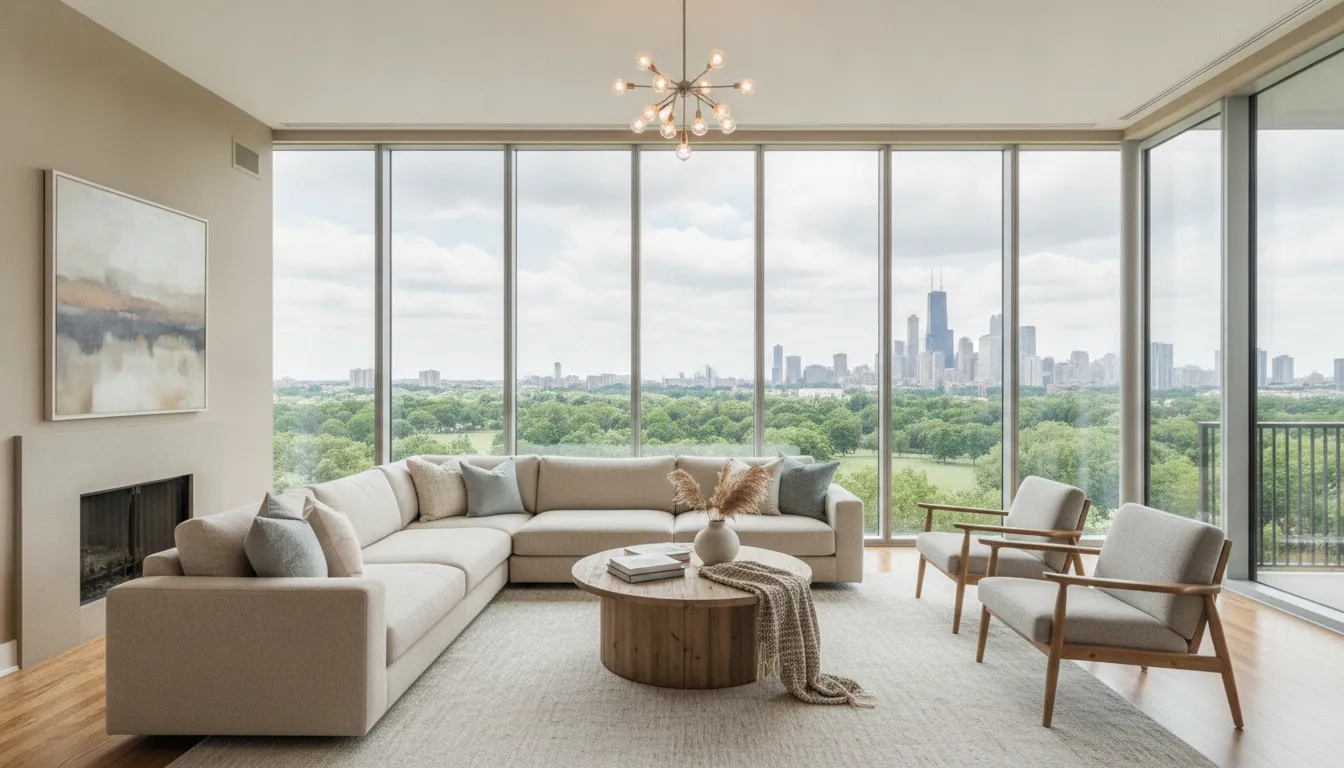
For window film large living room windows, the best choice depends on what the glass needs to do: reduce glare and solar heat, limit UV exposure, preserve daylight, add privacy, or improve safety. A professional review should also confirm that the film suits the exact glazing, especially when panes are large or insulated.
Large living room windows can make a Chicagoland home feel open and bright, but they can also put glare on screens, increase afternoon heat, and expose furnishings and flooring to fading. Film options range from virtually clear to more tinted finishes, while decorative choices can soften views without turning the room dark. Privacy also requires careful planning: a reflective daytime effect may reverse after dark when indoor lights are brighter. The right recommendation balances comfort and appearance with the way your family actually uses the room.
Start by identifying the dominant problem, then compare film categories, glass compatibility, and installation details before choosing a finish.
Request a free estimate for your living room windows
Choosing window film for large living room windows
The best window film for large living room windows depends on the problem you want to solve first. Start by identifying whether glare, solar heat, fading, privacy, or appearance is the main concern. Then consider how much daylight you want to keep, whether you need daytime or around-the-clock privacy, and what type of glass is installed. Large panes and unusual configurations deserve a professional assessment before a film is selected.
Match the film to the room’s biggest challenge
If bright sunlight makes the room uncomfortable or creates reflections on a television, solar-control film may be the right starting point. It can help manage glare and solar heat gain while still allowing you to choose a relatively clear appearance. Residential options range from virtually clear to highly tinted, so reducing brightness does not automatically mean making the room dark.
UV protection is another consideration when large windows face furniture, flooring, artwork, or fabrics. Film can help reduce UV exposure and fading, but product performance varies. Ask for the relevant specifications rather than assuming every film filters light in the same way. If privacy is the priority, a subtle reflective or tinted film may change daytime visibility, while a decorative finish can obscure views and preserve light more consistently.
For a broader overview of available residential window film options, compare the goals of each film category before focusing on shade or color. You can also choose window film for your living room using a room-by-room framework, but large living-room glazing adds an important compatibility question. Insulated, tempered, laminated, or specialty glass may not suit every film combination. The exact glazing, pane size, exposure, and frame configuration should guide the recommendation.
A professional review helps balance performance, daylight, privacy, and a factory-finished appearance. It also avoids treating a product-size restriction or glass-compatibility question as an afterthought.
Which window film category fits your living room?
The right category depends on what your large living room windows need to do. Solar-control film addresses glare, solar heat gain, UV exposure, and fading. Decorative or privacy film changes visibility and appearance. Safety and security film adds a protective layer when glass-breakage concerns matter. These functions can overlap, but they are not interchangeable.
Match the film to the problem first
Start with the discomfort you want to solve, then consider how much daylight and outside visibility you want to keep. Sullivan’s residential window film options range from virtually clear to highly tinted, so reducing glare does not automatically mean making the room feel dark. The selection should also account for the exact glass, pane size, orientation, and frame configuration.
| Category | Problems solved | Appearance and daylight tradeoff | When professional review matters |
|---|---|---|---|
| Solar-control | Glare, solar heat gain, UV exposure, and fading of furnishings, floors, artwork, and fabrics. | Available from subtle to darker shades. A carefully selected option can manage sunlight while preserving useful daylight. | Review the glass and film specification, especially for large or insulated panes, before choosing a performance film. |
| Decorative or privacy | Unwanted views, sightlines, and the need for a more distinctive finish. | Options range from subtle privacy tints to frosted finishes that obscure views while allowing light through. Reflective privacy can change after dark when indoor lighting is brighter, as explained by this privacy film overview. | Review the room’s day and night lighting, sightlines, and whether consistent privacy or open views are the priority. See decorative and privacy film. |
| Safety and security | Concern about glass fragments, vulnerable panes, or added protection around high-use areas. | Usually selected for protective function rather than a dramatic visual change. The final look depends on the product and glass. | Have a professional assess the existing glazing, pane dimensions, attachment details, and the protection goal. Explore safety and security film. |
For many rooms, the best starting point is not the darkest film. It is the category that addresses the dominant problem without sacrificing the view, daylight, or finished appearance you want. A professional review can narrow the choice before installation and confirm that the selected film suits the glass.
How do you balance glare, heat, UV protection, and natural light?
Large living room windows often need to solve several problems at once. Start by identifying which issue is most disruptive at different times of day. Morning glare may make a seating area uncomfortable, while afternoon sun may add heat and put flooring or furniture in direct exposure. The goal is not simply to choose the darkest film. It is to match the film’s light control and appearance to the room, the window’s orientation, and how you use the space.
Map the priority before choosing the shade
If reflected sunlight is the main concern, begin with a solar-control option selected to reduce glare while preserving a comfortable level of visible light. Read more about glare-reducing window film options before assuming a darker appearance is necessary. If afternoon warmth is the bigger issue, compare how heat-blocking film works and ask how the proposed film manages solar heat gain without making the room feel closed in.
UV protection is a separate performance question, not a substitute for glare or heat control. Sullivan’s residential film options include UV protection up to 99%, along with glare reduction and solar heat gain control. Product specifications should explain the relevant wavelength range and performance rather than relying on a broad percentage alone. The National Park Service notes that ordinary glass filters some UV and that film claims vary by the wavelengths measured. See the discussion of window film UV protection for more context.
Natural light is usually a design priority in a living room, so consider clear or lightly tinted options before moving to a deeper shade. Residential films range from virtually clear to highly tinted, which allows the recommendation to reflect both comfort and the desired view. The U.S. Department of Energy’s Building America Solution Center also explains how shading and solar control affect daylight and solar gain: review its guidance on windows and skylights. This is a performance-planning decision, not a promise of a particular energy-bill reduction.
Finally, compare the intended result with the room’s existing light. Our guide to preserving natural light with window film can help frame that choice. For large or insulated panes, have the exact glazing and film specification reviewed professionally before installation. A tailored recommendation can address glare, heat, UV, and daylight together rather than optimizing one factor at the expense of the others.
Can window film provide privacy without making the room dark?
Yes, but the right film depends on when you need privacy and how much natural light you want to preserve. A lightly tinted or reflective film can soften views through large living room windows while keeping the space brighter than a heavily tinted treatment. The important detail is that reflective privacy is usually controlled by the difference between indoor and outdoor light levels, not by the film alone.
Why reflective privacy changes from day to night
During the day, sunlight outside is typically brighter than the room. A reflective film can then create a mirrored effect on the exterior, making it harder for people outside to see in. After dark, the balance can reverse. Interior lights may be brighter than the outdoors, which can allow views into the room and reduce the one-way privacy effect. This daytime and nighttime limitation is also described by privacy film guidance on lighting conditions.
That makes reflective film a useful option for daytime privacy and glare control. It can make a living room more comfortable, but it should not be presented as a guaranteed 24-hour privacy solution. Closing shades or adjusting interior lighting may still be appropriate after sunset.
For more consistent privacy, consider a frosted or decorative finish. These films obscure the view through the glass while allowing useful daylight to pass through, so the room does not have to feel like a dark enclosure. Opacity and pattern can be selected to balance privacy with the amount of visibility and sunlight you want to retain. See decorative and privacy film options and the guide to preserving natural light with window film.
For large living room windows, a professional review helps match the privacy goal to the glass, exposure, and interior layout. Sullivan’s offers privacy film options for homes, including recommendations that distinguish subtle tint from more visibly frosted treatments.
Why glass compatibility matters for large windows
Large living room windows are not defined only by their size. The glass construction, exposure, framing, and existing coatings all affect which film is appropriate. A film that performs well on one pane may not be the right specification for another, particularly when the window is insulated, tempered, laminated, or already treated with a low-emissivity coating.
What should be reviewed before choosing a film?
Start by identifying the exact glazing. Insulated units contain separated panes, while tempered and laminated glass are manufactured for different performance and safety purposes. Sullivan’s residential guidance notes that many films can be used with single-pane, double-pane, tempered, and laminated glass, but compatibility still needs to be checked for the specific glass and film combination. The product specification matters as much as the broad glass category.
This review is especially important when the goal is to control solar heat gain. Window film changes how incoming sunlight is reflected, absorbed, or transmitted, and the exact glass and film combination should be checked before installation. On a large pane, the installer can also account for orientation, shading, frame condition, and existing coatings rather than assuming that one film specification suits every window.
A review should consider pane dimensions, orientation, shading, frame condition, glass markings, seal condition, and any existing coatings. It should also account for whether the film is being selected primarily for glare reduction, solar heat gain control, UV protection, privacy, or safety. These goals can call for different constructions and visible-light levels. Sullivan’s residential window film options are available across a range of appearances, but the right recommendation depends on the actual window rather than appearance alone.
For skylights, angled panes, unusually shaped glass, or other specialty configurations, use the same careful approach. Sullivan’s guide to film compatibility with specialty glass can help frame the questions, while an on-site or detailed professional review can confirm whether a selected film is suitable. Large glass does not automatically rule out film, and it does not automatically make every film appropriate. Precise specification is what protects the finished appearance and supports a responsible installation decision.
What should professional installation include?
Large living room windows deserve more than a quick film application. Professional installation should connect the glass, the film specification, and the finished appearance so the result looks intentional from inside and outside.
What to expect during the installation process
- Measure each pane and note frames, hardware, shape, and access.
- Confirm the glazing type and select a film specification that fits the glass.
- Plan edge clearances, seams, transitions, and the intended daylight level.
- Apply the film carefully, then review the finish, care instructions, and warranty.
The process should begin with accurate measurements of each pane, including height, width, shape, and any details around frames or hardware. Large or unusual configurations may need a closer assessment before a recommendation is finalized. The installer should also confirm the glazing type and selected film specification, since the right choice depends on the exact glass rather than window size alone. Sullivan’s recommends checking the glazing and film specification before selection, including for common single-pane, double-pane, tempered, and laminated glass applications. Professional residential window film service should include that review.
Before cutting, the installer should plan edge clearances, seams, and any transitions between adjoining panes. Precision cutting helps the film follow the glass cleanly without distracting gaps or uneven borders. During application, careful surface preparation and controlled handling matter just as much as the product itself. The goal is a clean, factory-finished appearance, not a visibly improvised patchwork of film.
Ask which film is being installed, what appearance and daylight level to expect, and how the manufacturer-backed warranty applies to the product and workmanship. A reputable installer should explain care instructions and the expected settling period without promising that every pane or configuration is suitable in advance. Sullivan’s has experience with some unusual window configurations, but each project still calls for an individual assessment.
Request a free estimate for your large living room windows
Frequently Asked Questions
What is the best window film for large living room windows?
The best film depends on the problem you want to solve. Solar-control film can help manage glare and solar heat while preserving a comfortable level of daylight. Decorative or frosted film is better when privacy is the priority, while safety film serves a different glass-protection purpose. A professional recommendation should also account for the window’s size, orientation, and glazing.
Can window film reduce glare and heat without making the room dark?
Yes. Residential films are available from virtually clear to highly tinted, so the selection can balance glare reduction, solar heat gain control, and natural light. The right appearance depends on the room’s exposure and how much brightness you want to retain. Samples and a review of the actual windows help prevent choosing a film that feels too dark.
Does privacy window film work at night?
Reflective privacy film is generally strongest during the day, when outdoor light is brighter than indoor light. After dark, interior lighting can reverse that visibility advantage, allowing people outside to see in. If you need more consistent privacy, frosted or decorative film can obscure views while still allowing daylight through.
Can window film be applied outside, and will it work with my glass?
Some specialty applications may call for exterior film, but the correct placement depends on the product and the window assembly. Large living room windows may be single-pane, double-pane, tempered, or laminated, and not every film suits every glazing combination. A professional should check the exact glass and film specification before installation.
Why is the estimate for large windows customized?
Large windows vary in dimensions, number of panes, access, frame details, exposure, glazing, and the result you want. Those factors affect the appropriate film category, installation plan, and finish. A custom, no-obligation free estimate allows the installer to review the glass, discuss glare. Heat, privacy, and daylight priorities, and recommend a suitable solution without publishing a one-size-fits-all price.
Ready to plan the right window film?
Large living room windows deserve a recommendation based on your priorities, natural light, and the exact glass in each opening. A professional review can help you compare film categories and plan a clean, factory-finished installation that suits the room.
Request a no-obligation free estimate for your living room windows