
Window clings are useful for temporary decoration or a small area of coverage. Professionally installed window film is often a better fit when you want a coordinated, longer-term treatment for privacy, appearance, or another defined glass need. The right choice depends on how much glass you need to cover, how long the change should last, and what the room needs the glass to do.
Discuss your window film needs
What is the difference between window clings and window film?
In brief: a cling is generally a removable, ready-made piece for a flexible or temporary change. Architectural window film is selected for an intended function and professionally applied to the glass. A cling can work well for a modest accent or short-term display. Film is worth considering when you want measured coverage, a more uniform finish, or a treatment selected for a specific purpose.
Clings are available in different shapes, designs, and sizes. They are often used for seasonal displays, small decorative details, or a limited visual screen. Their fit, adhesion, and service life depend on the product and the glass. The finished appearance also depends on careful placement and on whether the available size matches the pane.
Window film is a broad category, not a single material with one set of properties. Decorative film can create a frosted or patterned appearance. Privacy film is chosen to alter visibility, while solar-control film addresses solar heat gain and glare. Safety and security film has a different purpose again. These categories are not interchangeable, so it is important to match product specifications to the goal.
Sullivan’s is family-owned and operated and has provided professional window film installation in the Chicagoland area since 1988. Recommendations are based on the project and glass rather than an assumption that every product suits every window. The window film service overview explains the different application categories.
Which option works better for privacy?
First define the privacy problem. Do you need to obscure a small portion of one window, reduce views into a meeting room, or create a consistent visual boundary across multiple panes? A cling may serve a limited need, such as covering a small area or making a temporary display less transparent. Its size and pattern can limit the amount and placement of coverage.
Decorative privacy film can be selected and measured for the area that matters. Frosted or patterned finishes can obscure views while still allowing daylight into a space. The exact effect depends on the material, the opacity, and the angle from which someone looks through the glass. Think about the view from both indoors and outdoors rather than judging only from one side.
Lighting changes the privacy experience. A treatment that makes it difficult to see into a room during the day may work differently at night when interior lights are on. A reflective appearance should not be assumed to provide privacy in every condition. If privacy after dark matters, discuss the sightlines and consider whether a window covering or another measure is also needed.
For a home, note street-facing rooms, bathrooms, entry doors, and windows near a neighboring property. For a workplace, consider meeting rooms, reception areas, and glass partitions. Sullivan’s guide to privacy film for homes and its information about privacy film in offices offer relevant starting points.
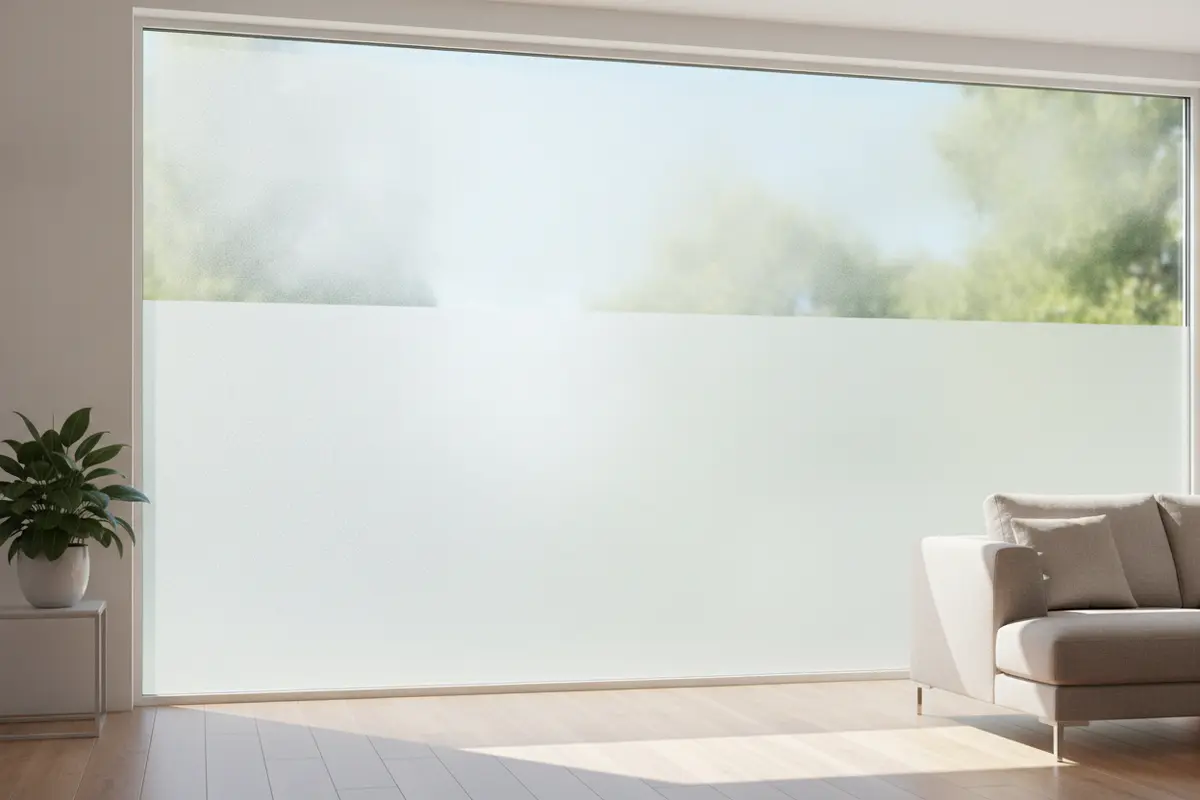
For example, a homeowner who wants to obscure the lower half of a street-facing living-room window might compare a small cling with a measured band of frosted film. The cling may be enough for a short-term need, but a sized film treatment can create a continuous line across the pane. In a conference room, the goal may be a consistent band across several panels; alignment and repeated measurements then become important parts of the decision.
How do decoration and branding needs change the choice?
A temporary campaign or seasonal window display can be a natural use for a cling. It may be possible to change the design as a promotion changes, and a small ready-made motif may be exactly what the space needs. Consider the intended duration, how noticeable the edges will be, and whether the piece can be removed or repositioned as the product instructions allow.
For a lasting interior design, a decorative film treatment can be planned around the pane, partition, or layout. Frosted finishes, patterns, and other decorative options can provide a visual boundary without replacing the glass. They can also help establish a consistent look across a group of windows. Sullivan’s articles on decorative film for homes and decorative film for office meeting rooms discuss examples of these settings.
Branding requires a few additional checks. Is the design meant to be temporary or part of the space for an extended period? Must it be seen from a particular side? Does it need to line up across multiple panes or remain consistent at different viewing distances? A cling can suit a short promotion; a professionally planned film design can be considered for a coordinated, longer-term treatment.
In either case, do not assume that a decorative effect also offers solar control, safety performance, or a particular level of privacy. Confirm those properties separately. The International Window Film Association’s consumer information about window film is a starting resource for learning about the product category; confirm the specific product claims and application details with the manufacturer and installer.
Which option looks more uniform on the glass?
Clings can have visible edges, seams, or gaps if their dimensions do not match the window. On a small pane or as an intentional accent, that may be perfectly acceptable. On a large window or a set of panes, uneven placement can draw attention, especially when viewed from across a room or in strong daylight.
Professional film installation is planned around the glass and the desired coverage. Measurements, alignment, and the pane edges all contribute to a consistent result. The aim is a factory-finished look that feels considered within the room, rather than a shape placed wherever it fits. Complex shapes and multiple panes call for assessment before choosing a material and layout.
Uniformity depends on more than installation. Glass condition, frames, viewing distance, room lighting, and the number of panels affect the final appearance. Ask how a proposed design will look from each side and how seams or edges will be handled. The project gallery can help you consider the appearance of professionally treated glass, while a comparison of glass stain and decorative film offers another design perspective.
How do durability and upkeep compare?
A temporary cling is meant to offer flexibility, but its performance over time depends on its material, glass condition, handling, and exposure to sunlight or moisture. Repeated repositioning can affect how neatly it sits. Dust at the edges or frequent contact may also make the piece more noticeable. Follow the product directions and avoid assuming every cling behaves the same way.
Professionally installed film is intended as a more integrated glass treatment. Film life and care vary by product and conditions. Many film products can last a decade or more with proper care, and warranties are available on most products; the precise coverage and terms depend on the selected film. Ask which product is being considered, what cleaning guidance applies, and what warranty covers that specific selection.
Cleaning is a practical part of the choice. For either option, use the manufacturer or installer instructions and avoid abrasive tools that could scratch a surface. For newly installed film, ask when normal cleaning can resume and whether there are initial care instructions. If a pane is touched often or cleaned frequently, mention that use before selecting a treatment.

Removal is another difference to weigh. A cling is generally intended to be taken down more readily, although the exact process depends on its material and condition. Removing installed film is a separate process and may require professional work depending on the adhesive, installation period, and glass. Read what homeowners should know about film removal before treating a long-term film choice as if it were a repositionable decoration.
How should you compare the options?
This comparison is a general planning aid, not a promise about every product. Clings and film vary, and the glass itself can affect suitability. Use the table to narrow down the questions you want answered before choosing.
| Consideration | Window cling | Professionally installed window film |
|---|---|---|
| Typical use | Temporary accent, small area, or short-term display | Planned privacy, decoration, solar heat gain control, or another defined glass application |
| Coverage | Usually limited by available sizes and shapes | Can be selected and measured for the intended pane or layout |
| Appearance | Fit and placement depend on the individual piece | Professional application aims for an even, coordinated finish |
| Changing the look | Often suits seasonal or frequently changed designs | Often considered for a stable, longer-term treatment |
| Product function | Depends on the specific cling and its stated purpose | Film category and specification should match the intended function |
| Care and service life | Varies by product, handling, and exposure | Varies by product; ask about care instructions and applicable warranty |
| Planning | Can be straightforward for a small, simple application | Requires assessment, measurements, product selection, and professional installation |
How can you make a useful side-by-side decision?
Try comparing the options against one actual window rather than judging them in the abstract. Start with the dimensions and a photo of the glass from inside and outside. Note whether the pane is part of a door, a partition, or a group of matching windows. This small inventory clarifies whether you are choosing a single accent or planning a visual treatment across a space.
- Write down the main outcome. Use a plain description such as “obscure the lower portion from the sidewalk” or “add a temporary seasonal accent.” Avoid combining several outcomes into one vague request.
- Set the intended duration. Decide whether the change is for an event, a season, or an ongoing part of the room. The expected duration helps identify how much planning and customization make sense.
- Mark the coverage area. For a single pane, identify the exact section that matters. For several panes, check whether a design needs to align from one window to the next. A small sample can look different from a full installation, so consider the complete layout.
- Review the view at different times. Look at the glass in daylight and after dark with interior lights on. Check privacy from the locations where people actually approach or use the space.
- Confirm the product’s function. Ask what the particular material is designed to do and what it is not designed to do. Request information on care, service life, and warranty where applicable.
For example, a small, temporary decoration on an interior office partition may not need a custom treatment if the cling size and appearance suit the project. In contrast, a series of conference-room panes requiring a repeated privacy band raises questions about precise coverage, alignment, and a consistent finish. For a home bathroom, the priority might be privacy at eye level while retaining daylight. These are different briefs, even if all three involve covering clear glass.
Keep a short list of open questions for the installer: Is the glass suitable for the proposed film? How will the edge or pattern line up with the frame? What will the treatment look like from each side? What does cleaning involve? Which warranty applies? A professional can assess the window and explain the options, while the final decision remains tied to the use and appearance you want.
What should you check before choosing?
A practical decision starts with the window and the job. Write down what you want to change before comparing products. That can help distinguish a decorative preference from a need for privacy or heat rejection, which may call for different options.
- How long should it stay in place? A seasonal design or temporary notice points toward a flexible option. A treatment intended to remain part of the room calls for a longer-term product discussion.
- How much glass needs treatment? A small pane may be simple to cover. Multiple panes, doors, or unusual shapes make measuring and planning more important.
- What is the main goal? Separate privacy, decoration, glare reduction, solar heat gain control, and safety. Different film categories address different needs, and decorative appearance alone does not establish another performance benefit.
- Who needs to see through the glass? Consider inside and outside sightlines, daylight, nighttime lighting, and whether the finish must look consistent from both sides.
- Will the design change? If you expect to replace it for each season or campaign, flexible decoration may be useful. If frequent change is not needed, consistency may matter more.
- What care is realistic? Ask how to clean the surface, what tools to avoid, and whether frequent contact affects the choice.
- Is the glass suitable? Have the glass and project conditions reviewed before selecting film. The pane and the proposed application should be considered together.
For more background, read the window film frequently asked questions and the decorative film ideas guide. If solar performance or another specific function is part of your brief, review the window film overview and ask what the selected product is designed to do.
When might a cling be the right choice?
A cling can be a sensible choice when the request is modest, temporary, and suited to the product. A homeowner might add a small seasonal accent to a smooth pane. A business might use a removable display for a short promotion. In these situations, an easily changed design may matter more than a uniform, long-term finish across the entire window.
Before applying one, check its directions and whether it is appropriate for the glass. Think about the size of the area, the desired location, and how the design will look from each side. If it needs to be moved later, follow the product’s removal guidance rather than pulling at it without checking. A cling can decorate a window, but it should not be expected to solve a broader privacy, glare, or comfort issue unless the product is specifically designed and documented for that purpose.
There is no need to treat clings as an inferior choice. They serve a different purpose. The key is to choose one with realistic expectations about coverage, appearance, lifespan, and function.
When is professionally installed film worth considering?
Film may be worth exploring when a window is part of everyday life in a home or business and the goal is more than a short-term decoration. Examples include creating a visual boundary in a meeting room, coordinating a treatment across several panes, adding a planned decorative element, or addressing solar heat gain with a product selected for that purpose.
A professional assessment can help identify what the glass needs and what it does not. The conversation can cover the pane, the intended effect, available film categories, expected appearance, care, and applicable warranty. For residential planning, see the residential window film guide. Business owners can compare commercial film types and their uses.
Sullivan’s offers free estimates and personalized recommendations. The proposal depends on project details such as measurements, selected film, complexity, and location; no single published price applies to every window. To make the discussion useful, note the room, the problem you want to address, your preferred appearance, and how long the treatment should last. You can also learn about Sullivan’s approach before deciding what to ask.
Request a free estimate for your glass
Frequently asked questions
Can window clings provide privacy?
A cling can obscure part of a pane depending on its size, design, placement, and the viewing conditions. For broader or more consistent coverage, compare privacy film options and consider how changing light affects visibility. If nighttime privacy matters, discuss it specifically rather than relying on a daytime appearance.
Can window film be decorative as well as practical?
Yes. Decorative film can add a frosted or patterned effect and may be selected to support a privacy or design goal. Do not assume the film also provides solar control or safety performance unless the particular product specifications support that use.
Is window film removable?
Film can be removed, but this is different from lifting a temporary cling. The process can depend on the product, how long it has been installed, and the condition of the glass and adhesive. Review removal guidance and ask a professional about the specific application before choosing a long-term treatment.
Does privacy film make a room dark?
Not necessarily. Films differ in opacity and design, so the effect on daylight and visibility depends on the selected product. Review samples in the room and discuss the lighting and sightlines before making a decision.
How do I find out what suits my windows?
Describe the concern, room, desired appearance, and expected lifespan. An assessment can help match those needs to an appropriate category and check the glass. You can also use Sullivan’s free estimate page to begin a project discussion.
Ready to choose a solution for your glass?
Choose based on the job: clings can work for temporary accents, while professionally installed film is worth considering for a measured, consistent treatment with a defined privacy, decorative, or solar-control goal. Compare coverage, appearance, maintenance, and product function before settling on an option.
Request a free estimate for a tailored recommendation
A conversation about the windows and the result you want is a practical first step toward choosing a suitable treatment.